
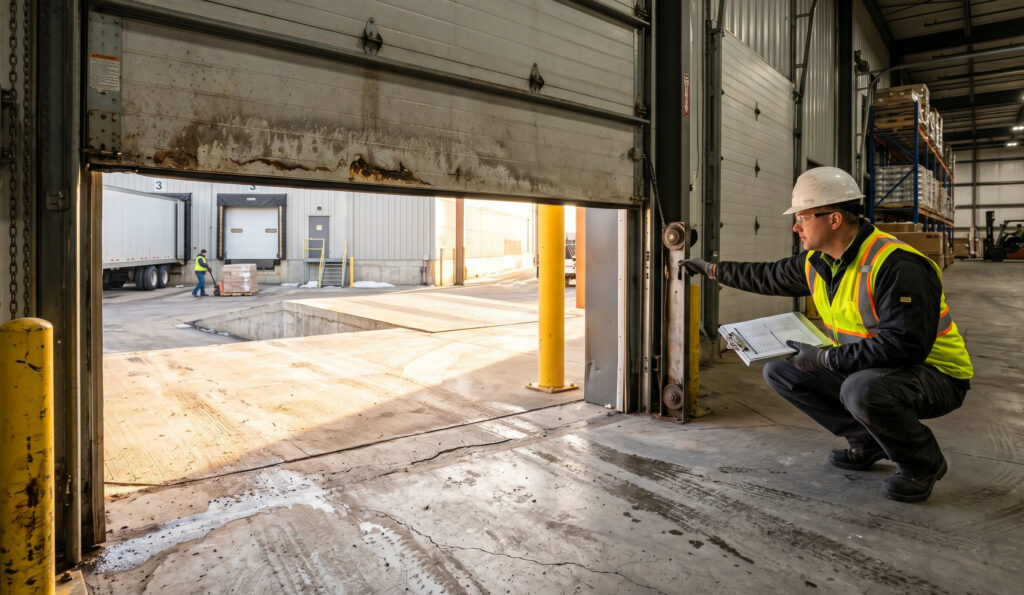
Winter is a grueling season for industrial infrastructure, but few components bear the brunt of the cold quite like your commercial doors. As the snow melts and the ground thaws, facility managers often breathe a sigh of relief, assuming the worst is over. However, the transition from winter to spring is frequently when the most critical issues come to light.
The freeze-thaw cycle, road salt, and extreme temperature fluctuations do more than just make operation difficult; they cause “silent” wear and tear. While a door that won’t open is an obvious problem, it is the microscopic fractures in springs, the hidden corrosion in tracks, and the hardened seals that lead to catastrophic failure during the busy spring and summer months.
For a facility manager, a proactive post-winter inspection isn’t just about maintenance it is about risk mitigation.
Why Winter is Historically Hard on Commercial Doors
To understand where to look for damage, we must first understand how winter attacks different door systems. The primary culprits are metal fatigue and material contraction.
When temperatures drop below freezing, metal becomes more brittle. For components under high tension, such as the springs in a sectional overhead door, this brittleness increases the likelihood of a sudden snap. Simultaneously, the lubricants used to keep rollers and tracks moving smoothly can thicken or “gum up” in the cold, forcing motors to work twice as hard to move the same weight. This puts an invisible strain on operators and drive chains that may not manifest as a failure until weeks after the weather warms up.
Furthermore, moisture is the eternal enemy of industrial hardware. In regions where salt or de-icing chemicals are used, the slush kicked up by vehicles often settles into the bottom slats of rolling steel doors or the bottom retainers of sectional doors. This leads to accelerated oxidation, compromising the structural integrity of the door from the ground up.
1. Sectional Overhead Doors: Checking the Mechanics
Sectional overhead doors are the workhorses of most loading docks. Because they consist of multiple moving parts, hinges, and rollers, they have numerous “failure points” that can be exacerbated by winter.
The Spring System
Most sectional doors rely on torsion springs. These springs have a finite cycle life. During winter, the metal undergoes significant thermal expansion and contraction. Inspect your springs for “gaps” or signs of rust. If you hear a loud “chatter” or popping sound when the door operates, the spring may be binding or reaching its elastic limit.
Rollers and Hinges
Check the rollers for flat spots. In the winter, if a roller gets stuck due to frozen debris in the track, it may slide instead of roll, wearing down one side. Once the ice is gone, that flat spot will cause the door to vibrate or “jump” in the track, which eventually damages the track’s alignment.
Weather Seals and Perimeter Gaskets
The rubber or vinyl seals at the bottom and sides of the door are designed to keep the elements out. However, these materials can become brittle and crack in extreme cold. If the bottom seal froze to the ground over the winter and the door was forced open, there is a high probability the seal is torn or the bottom retainer is bent. This leads to energy loss and allows pests to enter the facility during the spring.
2. Rolling Steel Doors: Identifying Hidden Corrosion
Rolling steel doors are prized for their durability and security, but their design makes certain types of damage harder to spot without a deliberate inspection.
Slat Alignment and Sludge
The interlocking slats of a rolling steel door can trap moisture and salt in the “curtain.” As the door rolls up onto the barrel, this corrosive mixture is compressed into the coil. Check the “guides” (the vertical tracks) for buildup. If there is a grinding sound during operation, it’s often a sign that salt and grit are eating away at the galvanized coating of the slats.
The Barrel and Counterbalance
The internal components of a rolling steel door – the barrel assembly and the enclosed springs – are shielded from view, but they are not immune to temperature shifts. Condensation can form inside the barrel as the warehouse warms up while the exterior remains cold. This internal moisture can lead to “hidden rust” that weakens the counterbalance system.
3. High-Speed Doors: Assessing the Sensors and Fabric
High-speed doors are precision instruments designed for high-traffic environments. Because they move at speeds often exceeding 60 inches per second, even minor winter-related issues can lead to major malfunctions.
Sensor Calibration
Winter weather often brings fog, steam, and heavy condensation. These environmental factors can cloud the lenses of photo-eyes and motion sensors. Additionally, if the building shifted slightly due to frost heave in the soil, your safety sensors may no longer be perfectly aligned. A door that “ghost opens” or refuses to close is often suffering from a misaligned or dirty sensor.
Fabric Integrity and Heat Seals
In cold storage or exterior high-speed applications, the PVC or fabric curtain can lose its flexibility. Check for stress fractures along the fold lines. If the door has a “breakaway” feature (designed to reset after an impact), ensure the tracks are clear of any winter debris that might prevent the door from re-seating correctly.
The Operational Audit: A Step-by-Step Checklist
Facility managers should perform a “walk-around” inspection at the start of the second quarter. Use the following criteria to evaluate your doors:
- Listen to the Motor: Does the operator sound like it is straining? An increase in decibel level usually indicates a lack of lubrication or a door that has fallen out of balance.
- Observe the Movement: Does the door hesitate at the halfway point? Does it “rake” (hang lower on one side)? If a door isn’t level, the cables on one side are likely stretched or the drum is misaligned.
- Check the “Bottom Two Feet”: This is where 90% of winter damage occurs. Look for bubbling paint (a sign of rust), bent retainers, and cracked weather stripping.
- Test the Safety Reversal: Regulations require that doors reverse when they hit an object. Cold weather can harden the “sensing edge” on the bottom of the door, making it less responsive. Test this with a 2×4 piece of wood to ensure the door reacts immediately.
The Importance of Professional Calibration
While a visual inspection is a great first step, some issues are invisible to the naked eye. For example, a torsion spring may look perfectly fine but have lost the “torque” necessary to lift the door safely. This forces the motor to pull more “amps” than it is rated for, which will eventually burn out the circuit board or the motor windings.
Professional maintenance involves checking the balance of the door. A properly balanced 500-pound rolling steel door should be easy enough to lift halfway by hand. If the door feels heavy or slams shut, it is an accidents waiting to happen.
In many cases, winter damage is the catalyst for a new installation. If the cost of repairing rusted slats, replacing springs, and fixing a burnt-out motor approaches 50% of the cost of a new, energy-efficient high-speed or insulated sectional door, the “repair vs. replace” math begins to favor replacement. Modern doors offer significantly better R-values and faster cycle times, which pay for themselves in energy savings.
The Spring Automation Audit
Spring is the optimal time to transition from “survival mode” to “optimization mode.” Waiting until a door fails during a peak shipping window can result in thousands of dollars in lost productivity and emergency repair premiums.
At Frontier Overhead, we specialize in the unique needs of commercial and industrial facilities. Our team understands that a door is not just an entrance—it is a critical component of your facility’s workflow and thermal envelope.
To ensure your facility is ready for the demands of the coming year, we invite you to schedule a Spring Automation Audit. We will perform a comprehensive multi-point inspection of your rolling steel, high-speed, and sectional doors, checking everything from spring tension and cable integrity to sensor calibration and motor health.
If you need assistance, contact Frontier Overhead to schedule your inspection and keep your operations moving smoothly.